
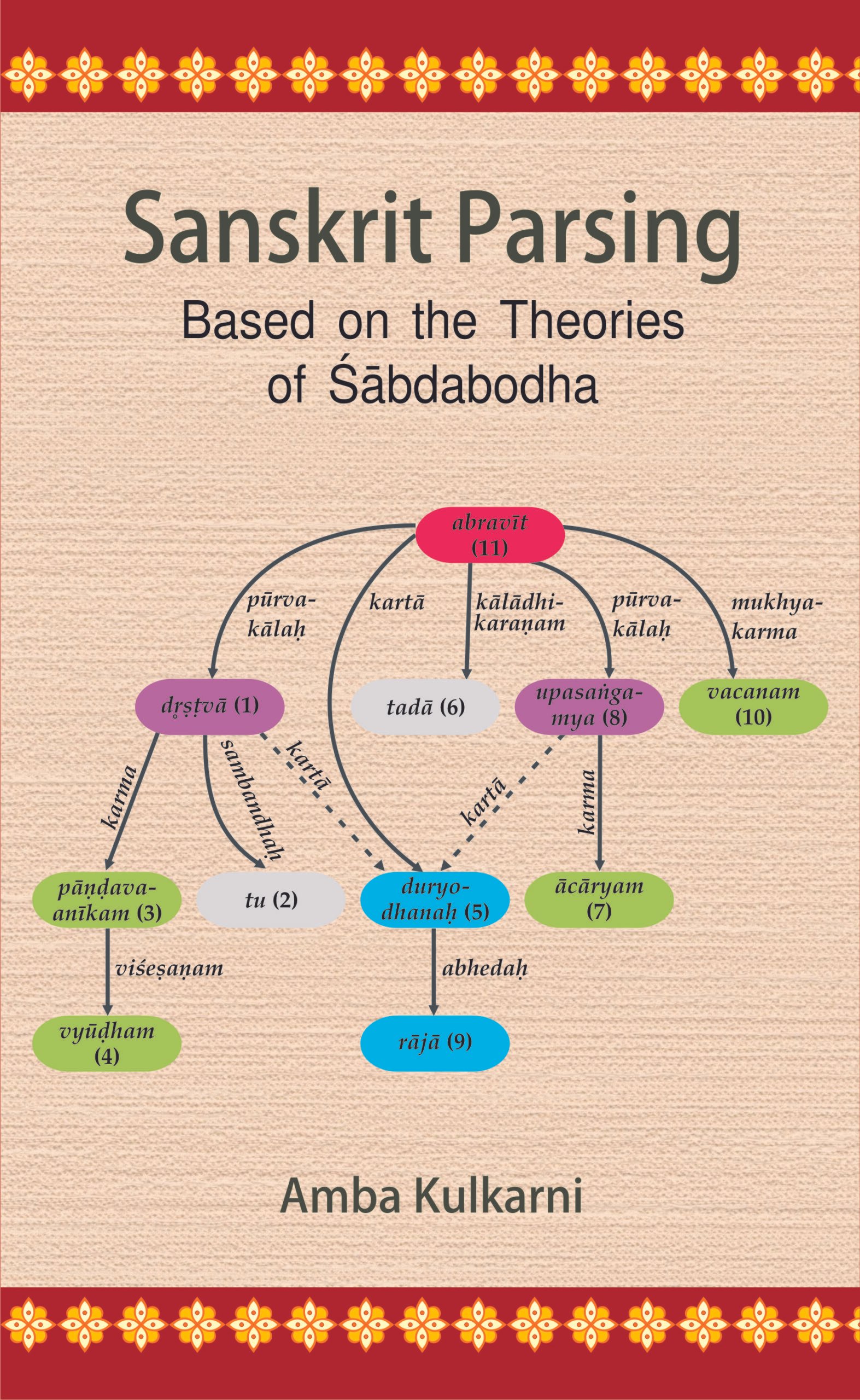

This book presents the key concepts from the Indian Grammatical Tradition (IGT) that are necessary for understanding the information flow in a language string and its dynamics. This is followed by a concrete application of building a parser for Sanskrit using the framework of Indian Grammatical Tradition.
₹900.00 Original price was: ₹900.00.₹810.00Current price is: ₹810.00.
India has a rich grammatical tradition, still extant in the form of Panini’s grammar as well as the theories of verbal cognition. These two together provide a formal theory of language communication. The formal nature of the theory makes it directly relevant to the new technology called Natural Language Processing.
This book, first presents the key concepts from the Indian Grammatical Tradition (IGT) that are necessary for understanding the information flow in a language string and its dynamics. A fresh look at these concepts from the perspective of Natural Language Processing is provided. This is then followed by a concrete application of building a parser for Sanskrit using the framework of Indian Grammatical Tradition.
This book not only documents the salient pieces of work carried out over the last quarter century under Computational Paninian Grammar, but provides the first comprehensive exposition of the ideas involved. It fills a gap for students of Computational Linguistics/Natural Language Processing who are working on Indian languages using Paninian Grammatical Framework for developing their computational models and do not have direct access to the texts in Sanskrit.
Similarly for the Sanskrit scholars and the students it provides an example of concrete application of the Indian theories to solve a contemporary problem.


₹1,100.00 Original price was: ₹1,100.00.₹990.00Current price is: ₹990.00.

₹1,200.00 Original price was: ₹1,200.00.₹1,080.00Current price is: ₹1,080.00.

₹795.00 Original price was: ₹795.00.₹716.00Current price is: ₹716.00.
| There are no products |

Dr Arjuna S R –
This book is an exceptional research work by Prof Amba Kulkarni. This is an outcome of her research during her stay at the prestigious Indian Institute of Advanced Studies (IIAS), Shimla as a Research Fellow. It is highly useful for scholars working on Language Technology/NLP/Machine Translation and other similar research areas. The amalgamation of the theories of Ancient Indian Knowledge System and Computational Linguistics is wonderfully illustrated in this book.
This work has all the elements to be included in the curriculum of colleges/universities connected with Sanskrit Studies/Liberal Arts/Language Science and even in the Engineering colleges as well. I have suggested this book for our library at Philosophy Dept, MAHE, Manipal.